miércoles, 13 de abril de 2011

Vocabulary 2 - Elements and Atoms

Element: a substance that cannot be broken down any further into anything simpler.
Atom: the smallest particle of an element that has the same chemical properties as the elements.


Nucleus: an atom`s dense center, where most of it mass is.


Electron: a negatively charged particle that moves around an atom`s nucleos.


Proton: a positively charged particle inside an atom`s nucleus.


Neutron: a particle with no charge inside an atom`s nucleos.


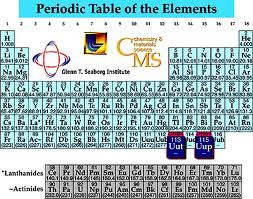
Atomic Number: the number of protons in an atom.


Metal. any of a group of elements that conduct heat and electricity, is shiny and bendable.

sábado, 12 de marzo de 2011

Vocabulary 1 - Physical Properties

1. Matter: any solid, liquid or gas.

2. Mass: amount of matter in an object.


3. volume: the amount of space an object takes up.


4. Density: the amount of mass in a certain volume of material.

5. Physical Property: a property that can be observed without changing the the identidy of a substance.

6.  Physical Change: a change in size, shape, or state without forming a new substance.

7. Solution: a mixture of one substance dissolved in another so that the properties are the same throughout.

8. Chemical change: a change in matter that produce a new substance withh different properties of the original.

sábado, 27 de noviembre de 2010

Summary # 7 How ecosystems change

Abandoned Farm- First year a comunity of crabgrass, insects and mice,
invades the field were corn once grew.


Second and third years ragweed, and tall grasses grow among the crabgrass. It can easily survive in the shade cast.

Four to Six Year Later The hot, dry field of tall weeds provides a perfect environment. More birds join the community.

Twenty five years later pine forest has replaced the old farm field.  Yet the number of new pine seedlings drops bacause they can´t grow in the shade.raccoons and foxes begin to visit.

One Hundred Years Later The forest is now mostly decidius trees. These trees are habitats of many different kind of animals.


jueves, 18 de noviembre de 2010

Summary#6 Places to live around the world

There are two biomes: Land and water biome, the water biome is divided in 2: fresh water and salty water. The fresh water is divided in 3: the plankton that floot in the water, Nekton that swim through the water, Benthos: bottom-dwelling. Salty water is divided in 2 : interdial: 200m depth, Open ocean is upper region 100-200 depth - Lower region: 200-1000m depth.
The land biome is divided in 6: Desert, Tundra, Grassland, Decidious Forest, Taiga, Tropical Rain Forest.


Salty Water


Fresh water


martes, 26 de octubre de 2010

Summary #5 Surviving in the Ecosystem

Animals are important because they control the population. Like, with frogs there were many insect or if there is no lions there were many deers.There are many animals that adapt like the polar bear in cold places. He adapts with his skin, his claws, the clouds and many others. If he will be in Panama he will die. That is the same with the camel if he will go to antartida he will die. But the only animal that an be adapted in all places is the human. The human doesn't have skin or fingernails that is use to be adapted but we have one thing intelligence.Now were going     to talk about symbiosis. Symbiosis is oraganism relating for a long time.Symbiosis is divded in three. Parasitism, Mutualism and commensalism. Parasitisim is One organism benefits and the other harms.One example is the flea nad the dog. The flea benefits and the dog harms. Another example is the plant and coling dobber plant. The coiling dobber plant benefits and the plant harms. Mutalism is Both oraganism benefits.One example is the yucca tree and the yucca months. The yucca month help the yucca tree to reproduce.Commensalism is one organism benefits and the other does not harms. One example is the orchid and the trees.


Summary # 4 - Cycles of Life

There are many cycle. But the more importants are water cycle, carbon cycle, and nitrogen cycle. The water cycle begins with evaporation. Next with condesation that includes precipitation also . Then the freezing. Finally the evaporation again. The carbon cycle includes the living things and some gases. The persons , fire and cars give to the plants CO2 and the plants need it to grow. And the plants give us HO2 for survive. Finally we hhave the nitrogen cycle. It begins with the atmosphere . Then it goes to the soil that  creates the ammonia the the nitrites and finally the nitrates. After we start over. The nitrogen is the more necesary of the gases.

lunes, 18 de octubre de 2010

summary #3 - Food chain and Food web

Food chain is energy and Food web is eating.In Food chain start with the sun then with a leaf . After with a worm. Next with a chicken. Then with the human. And finally with a bacteria. The more powerful of all. Now the food Web. We have a tree ( producer) , a Jiraffe( consumer 2 class Herbivorous) , a Leon ( cosumer 1 class carnivorous) and a bacteria ( consumer diposed) The leon eats the jiraffe the jiraffe eats the tree( leaves) and the bacteria eats the jiraffe and the lion.